“`html
What Is a Valve Sizing Guide?
Direct Answer
A valve sizing guide is an engineering methodology for determining the correct valve flow coefficient (Cv or Kv) based on required flow rate and allowable pressure drop. It ensures the selected valve operates within its stable control range without oversizing or undersizing. Proper sizing is a critical step within any industrial valve selection framework for both liquid and gas applications.
Key Takeaways
- Cv (or Kv in SI units) quantifies the flow a valve passes at a given pressure drop — refer to the Cv calculation methodology for the full derivation and worked examples.
- Oversized control valves operate near the closed position, causing instability, hunting, and accelerated trim wear; undersized valves restrict flow and create excessive pressure drop.
- Sizing criteria differ fundamentally between throttling control valves and on/off isolation valves — review control vs isolation valve differences before applying sizing equations.
- All sizing calculations must account for fluid phase, density, viscosity, temperature, and the system’s allowable pressure drop at minimum, normal, and maximum flow conditions.
How Does Valve Sizing Work?
Valve sizing translates process flow requirements into a quantified Cv value, which is then matched to a commercially available valve size. The process follows four sequential steps — each step depends on the outputs of the previous one, and errors at any stage propagate directly into an incorrect valve specification.
Step 1: Define Process Flow Parameters
The sizing process begins with a complete characterization of the process fluid and its operating envelope. Engineers must define flow rate at minimum, normal, and maximum conditions; fluid phase (liquid, gas, steam, or two-phase); density and viscosity at operating temperature; and the full temperature range across all scenarios. These parameters feed directly into the Cv equations and determine which calculation method — liquid, compressible gas, or steam — applies. Consulting a resource on valve selection by media ensures fluid-specific properties are correctly identified before sizing begins. For steam service, additional considerations including superheat, quality, and condensate formation are addressed in the steam valve selection requirements guidance.
Step 2: Determine Allowable Pressure Drop
Allowable pressure drop (ΔP) across the valve is not a free variable — it is constrained by the system pressure profile, available pump head or compressor discharge pressure, and the pressure sensitivity of downstream equipment. Assigning too large a ΔP to the valve starves downstream equipment of pressure; assigning too little results in an oversized valve with insufficient authority to control flow. The engineer must map the full pressure budget from source to destination under all flow scenarios before a ΔP value is assigned to the valve. For high-pressure systems, confirming that the valve pressure class is consistent with the system maximum is equally essential — the pressure class selection guide provides the ASME rating tables and decision criteria required for this verification.
Step 3: Calculate Required Flow Coefficient (Cv)
With flow rate and allowable pressure drop defined, the required Cv is calculated using standardized ISA 75.01 / IEC 60534-2 equations. For incompressible liquids, the fundamental relationship is:
Cv = Q × √(SG / ΔP)
where Q is flow rate in US gpm, SG is specific gravity relative to water, and ΔP is the pressure drop in psi. For compressible gases and steam, expansion factor (Y) and specific heat ratio corrections are applied to account for density changes across the valve. The calculated Cv represents the minimum required — the selected valve must meet or exceed this value at its specified travel position without exceeding the installed gain limits. The complete Cv calculation guide provides worked examples for liquid, gas, and steam service. In liquid applications with high ΔP, the engineer must also evaluate whether the calculated inlet pressure and ΔP combination creates conditions for flashing or cavitation — both of which require cavitation resistant valve design to be specified.
Step 4: Select Nominal Valve Size
The nominal valve size is selected by matching the calculated Cv to a manufacturer’s published Cv table and confirming the valve operates within the 20–80% travel range at normal flow conditions. Operating below 20% open places the closure element in an unstable, high-velocity zone that accelerates erosion; operating above 80% open leaves insufficient control authority for flow regulation. The installed flow characteristic — which differs from the inherent characteristic due to piping pressure losses — must also be verified to confirm adequate rangeability across the full flow envelope. Selecting a valve one pipe size larger than calculated is a frequently made error that compounds controllability problems; this and related pitfalls are documented in common valve selection mistakes. For applications requiring large Cv values at high flow rates, high flow valve selection criteria provide additional guidance on body type, trim configuration, and noise attenuation requirements.
Main Components Influencing Valve Sizing
Valve sizing does not operate in isolation from hardware — the physical components of the valve directly constrain the achievable Cv, flow characteristic, shutoff class, and actuator force requirements. Each component must be evaluated in the context of the sizing output.
Valve Body Geometry
The body geometry — including bore diameter, port area, and flow path configuration — establishes the maximum achievable Cv for a given nominal size. Full-bore designs maximize Cv and minimize pressure drop; reduced-bore and angle-body designs trade Cv capacity for improved flow directionality or space constraints. A ball vs gate valve comparison illustrates how two full-bore valve types achieve very different Cv profiles due to their internal geometry, and why body selection must follow rather than precede the Cv calculation.
Trim and Flow Characteristic
The trim — comprising the plug, cage, disc, or ball geometry — defines the valve’s inherent flow characteristic: linear (equal increments of travel produce equal increments of Cv), equal percentage (each increment of travel produces a percentage increase in Cv), or quick-opening. The inherent characteristic must be selected to produce an acceptable installed characteristic once the piping pressure profile is applied. Globe valves with contoured plugs and cages offer the most precise characteristic control; butterfly valves provide a quasi-linear characteristic that is less predictable at low openings. Reviewing globe vs butterfly valve differences helps engineers select the trim geometry that best supports the required installed flow characteristic.
Seat Design and Leakage Class
Seat design affects both shutoff performance and the minimum controllable flow — a valve that cannot close to its leakage class specification under the actual differential pressure will fail its functional test. Soft seats achieve Class VI shutoff but are temperature and pressure limited; metal seats achieve Class IV–V at higher temperature and pressure ratings. The seat must be sized and specified consistently with the Cv and ΔP requirements to ensure it seals under maximum differential pressure at shutoff. A detailed metal seat vs soft seat comparison provides the selection criteria for matching seat design to service conditions.
Actuator Torque Requirements
Once Cv and nominal size are established, the actuator must be sized to generate sufficient torque or thrust to stroke the valve from closed to open — and to maintain position — under the maximum differential pressure condition. Actuator sizing is derived from the valve’s published breakaway torque data at rated ΔP and must include a safety margin of typically 1.25–1.5×. Fail-safe action (spring-return vs double-acting) also affects the sizing calculation. The valve actuation selection guide covers actuator sizing methodology, fail-safe specification, and the relationship between valve Cv rating and required actuator output force.
Advantages of Proper Valve Sizing
Correct valve sizing is not a theoretical exercise — it produces measurable, quantifiable improvements in process stability, energy efficiency, and equipment reliability from the first day of operation.
Improved Flow Stability
A valve operating in the 20–80% travel range delivers consistent, repeatable control response across the full process load range. This reduces controller output oscillation, prevents process upsets caused by valve hunting, and maintains tighter control of downstream process variables such as pressure, level, and temperature. Stable flow control is a direct outcome of applying industrial valve selection principles — of which accurate sizing is the quantitative foundation.
Reduced Energy Loss
An oversized valve operating near closed position dissipates excess energy as turbulent pressure drop across a partially open closure element. This wasted head must be compensated by increased pump or compressor energy consumption. Correctly sizing the valve to accept only the required ΔP — and no more — minimizes irreversible pressure loss, reduces pump operating costs, and lowers the overall energy demand of the piping system over its service life.
Lower Maintenance Frequency
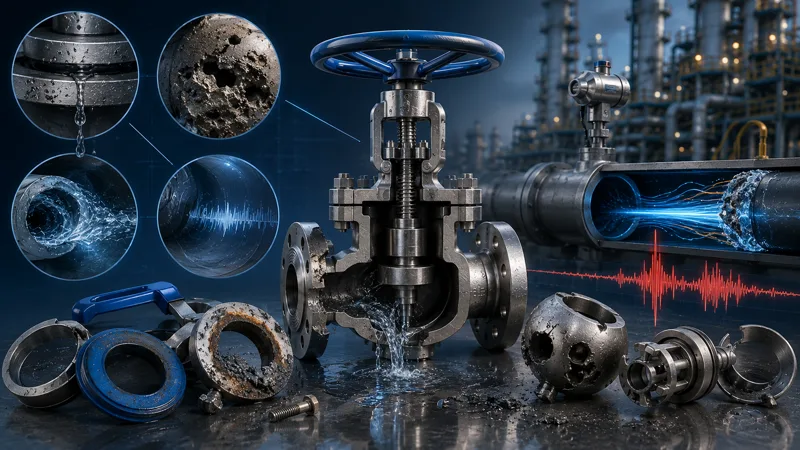
Valves operating outside their stable sizing range experience accelerated trim erosion, seat damage, packing wear, and stem fatigue. Near-closed operation creates localized high-velocity jet streams that erode trim surfaces in weeks rather than years. Correctly sized valves distribute the control action across a wider travel range, reducing the mechanical stress on all wetted components and extending the mean time between maintenance intervals. The most common root causes of accelerated wear are documented in premature valve failure causes, most of which trace back to incorrect initial sizing.
Typical Applications
Valve sizing requirements vary significantly across industries and service types, with each application imposing specific constraints on the Cv calculation methodology, sizing margins, and acceptable valve travel range.
Control Valves in Process Plants
Continuous process plants — refineries, petrochemical units, chemical reactors, and pharmaceutical facilities — depend on precisely sized control valves to maintain setpoints for temperature, pressure, flow, and level. These valves cycle continuously and must maintain their Cv characteristic throughout years of operation. The functional distinction between modulating control and block isolation is foundational to correct sizing — as detailed in the control vs isolation valve reference — since applying isolation valve sizing logic to a control application produces an uncontrollable result.
High-Pressure Pipeline Systems
Transmission pipelines and high-pressure injection systems operate at pressure ratings where small errors in Cv specification result in large deviations in delivered flow or system pressure. Sizing must account for compressibility effects at high gas pressures, choked flow conditions, and the influence of pipe reducers on the installed Cv. Detailed guidance on valve for high pressure service covers the additional sizing corrections required for these conditions.
Cryogenic Service
Cryogenic applications introduce fluid property challenges that require temperature-corrected density and viscosity values in the Cv equations, as well as verification that the valve remains within its stable travel range despite significant fluid property variation between warm startup and full cryogenic operating conditions. Cryogenic valve selection principles address these sizing corrections alongside the material and design requirements specific to low-temperature service.
Slurry and Abrasive Service
Slurry service sizing must account for the effective specific gravity of the slurry mixture — not the carrier fluid alone — and must apply erosion-based derating factors to published Cv values when hardened trim materials are used. Full-bore valve designs are preferred to minimize blockage risk, which also affects the effective Cv under partial solids loading conditions. The slurry valve selection guide provides slurry-specific sizing adjustments and trim material recommendations.
Frequently Asked Questions
What happens if a valve is oversized?
An oversized control valve operates near the closed position at normal flow conditions, placing the trim in an unstable high-velocity zone. This causes hunting, poor setpoint control, accelerated erosion, and frequent maintenance interventions. Avoiding this outcome requires applying the correct Cv calculation from the outset — the Cv calculation guide provides the methodology to prevent oversizing errors before they reach the field.
How is Cv different from nominal valve size?
Nominal valve size (NPS or DN) refers to the pipe connection diameter; Cv is a dimensionless flow capacity rating that quantifies how much flow the valve passes at a defined pressure drop. Two valves of the same nominal size can have very different Cv values depending on body geometry and trim design. Valve sizing determines the required Cv first; nominal size is selected afterward by matching Cv to manufacturer data. Refer to the comprehensive valve selection guide for context on how sizing fits within the broader selection sequence.
Do isolation valves require Cv sizing calculations?
Isolation valves are primarily sized for full-bore flow capacity and pressure drop in the fully open position, rather than for rangeability or flow characteristic. However, a pressure drop check at maximum flow is still required to confirm the valve does not restrict system throughput. For on/off applications with strict shutoff requirements, leakage class verification takes priority over Cv optimization — the control vs isolation valve comparison clarifies how sizing priorities differ between these two valve functions.
Is valve sizing required for high-pressure systems?
Yes — high-pressure systems require sizing calculations that include compressibility corrections, choked flow evaluation, and pressure class verification, all of which are more consequential at elevated pressures than at low-pressure service. Errors in Cv specification at high pressure translate directly into larger flow deviations and greater risk of cavitation, flashing, or acoustic noise. The complete valve selection methodology integrates sizing with pressure class selection to ensure both criteria are addressed together.
Conclusion
Valve sizing is the quantitative core of the valve specification process — it translates process flow requirements and system pressure constraints into a defined Cv value that drives nominal size selection, trim design, and actuator torque specification. Sizing must be performed in conjunction with pressure class verification and material compatibility assessment to produce a complete, internally consistent valve specification. Isolating sizing from these adjacent decisions produces specifications that are mathematically correct but practically deficient. Engineers requiring a unified framework that integrates sizing with type selection, pressure class, material, and actuation criteria should reference the comprehensive valve selection guide as the governing document for all valve specification activities.
“`