“`html
What Is a Cv Calculation Guide for Control Valves?
Direct Answer
The flow coefficient Cv quantifies a valve’s flow capacity — specifically, the volume of water in US gpm that passes through the valve at a pressure drop of 1 psi. Cv calculation determines the correct valve size by relating required flow rate, allowable pressure drop, and fluid properties. It is the mathematical core of any industrial valve selection framework.
Key Takeaways
- Cv is calculated using standardized ISA 75.01 / IEC 60534-2 equations that differ for liquid, gas, and steam service — the valve sizing guide explains how Cv integrates into the full sizing sequence.
- Liquid Cv calculations assume incompressible flow; gas and steam calculations require compressibility corrections, expansion factors, and choked flow evaluation at high pressure differentials.
- When calculated ΔP approaches the fluid’s vapor pressure, cavitation or flashing risk must be assessed — consult the cavitation resistant valve design resource before finalizing the specification.
- Cv requirements differ fundamentally between throttling control valves and on/off isolation valves — verify the valve function first using the control vs isolation valve differences reference.
How Does Cv Calculation Work?
Cv calculation follows a structured methodology that begins with defining the valve’s service conditions and ends with a verified flow coefficient that can be matched to a manufacturer’s published data. The calculation method changes depending on whether the fluid is incompressible liquid, compressible gas, or steam, and must be extended to address cavitation and flashing in liquid service at elevated pressure drops.
Definition of Cv and Standard Conditions
Cv is defined as the flow of water at 60°F (15.6°C), in US gallons per minute, that produces a pressure drop of 1 psi across the valve at a specified travel position — typically fully open. This standardized reference condition allows Cv values from different manufacturers and valve types to be compared on a consistent basis. The equivalent SI unit is Kv, defined as the flow of water in m³/h producing a pressure drop of 1 bar; the conversion relationship is Cv = 1.156 × Kv. A higher Cv indicates greater flow capacity at a given pressure drop. The complete valve sizing guide explains how the required Cv is derived from process conditions and matched to a nominal valve size. Within the broader industrial valve selection principles framework, Cv calculation is the quantitative step that converts engineering process data into a hardware specification.
Liquid Flow Cv Formula
For incompressible liquids, the fundamental Cv equation is derived from the Bernoulli principle and expressed as:
Cv = Q × √(SG / ΔP)
where Q is volumetric flow rate in US gpm, SG is the fluid’s specific gravity relative to water at 60°F, and ΔP is the pressure drop across the valve in psi. This equation assumes fully turbulent, non-flashing, non-cavitating flow with no significant viscosity correction. For fluids with kinematic viscosity above approximately 40 cSt, a viscosity correction factor (Fp) must be applied, which reduces the effective Cv and requires a larger valve than the basic equation indicates. Fluid-specific properties — density, viscosity, and chemical composition — vary significantly across process media, and selecting the correct reference values for each is addressed in the valve selection by media guidance.
Gas and Steam Cv Calculation
Compressible fluids — gases and steam — require modified Cv equations that account for density variation across the valve as pressure drops. The ISA/IEC methodology introduces an expansion factor Y (ranging from 1.0 at low ΔP/P₁ ratios to 0.667 at choked flow) to correct for gas expansion, along with the specific heat ratio factor Fk. The general gas Cv equation takes the form:
Cv = Q / (N₇ × Fₚ × P₁ × Y) × √(T₁ × Z / (MW × x))
where x is the pressure drop ratio ΔP/P₁, T₁ is inlet temperature in Rankine, Z is the compressibility factor, and MW is molecular weight. When x reaches the critical pressure drop ratio xT (the choked flow limit), further increases in ΔP produce no additional flow increase — the valve has reached sonic velocity at its vena contracta. Steam calculations follow the same framework but use steam-specific enthalpy and density corrections. Guidance on steam-specific sizing parameters is provided in the steam valve selection guide. For high-pressure gas systems where choked flow is likely, additional verification steps are required — as detailed in the valve for high pressure service reference.
Cavitation and Flashing Considerations
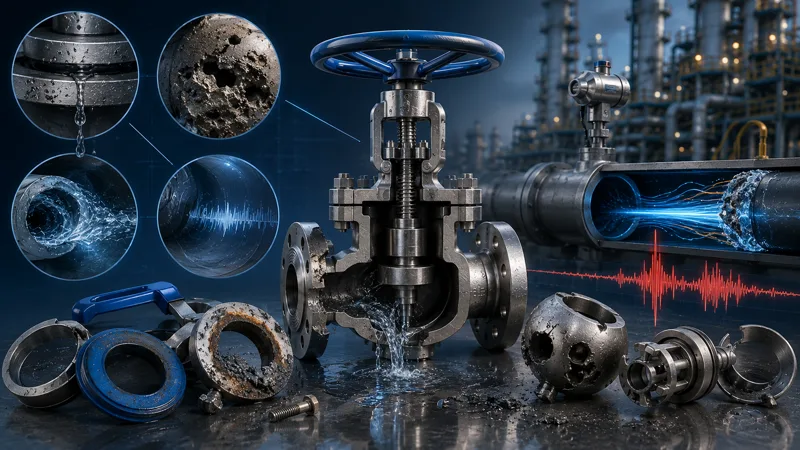
In liquid service, when the local pressure within the valve drops below the fluid’s vapor pressure at operating temperature, vapor bubbles form — a condition called cavitation. When these bubbles collapse downstream, they release localized shock waves that erode trim surfaces and valve bodies within a very short operational period. If the downstream pressure also remains below the vapor pressure, the bubbles do not collapse and the fluid exits as a two-phase mixture — a condition called flashing. Both phenomena are predicted by evaluating the pressure recovery factor (FL) against the inlet pressure and vapor pressure: if ΔP exceeds FL² × (P₁ − Pv), cavitation damage is probable. Neither cavitation nor flashing is a reason to simply select a larger valve — oversizing typically worsens both conditions. The correct response is to apply cavitation resistant valve selection criteria, including multi-stage pressure reduction trim or anti-cavitation cages. Ignoring these phenomena at the Cv calculation stage is one of the most consequential common valve selection mistakes encountered in liquid service applications.
Main Components Affecting Cv
The published Cv of a valve is determined by its internal geometry and component design. Understanding which components govern Cv capacity allows engineers to evaluate manufacturer data critically and verify that the specified valve will deliver the required flow coefficient under actual service conditions.
Valve Body Geometry
The valve body establishes the maximum possible Cv through its bore diameter, flow path length, and internal port geometry. Full-bore bodies maximize Cv relative to pipe size; reduced-bore and angle-body designs accept a lower Cv in exchange for improved flow directionality, reduced erosion, or space savings. A ball vs gate valve comparison illustrates how two full-bore valve types achieve markedly different Cv values due to differences in internal flow path geometry, even at the same nominal pipe size.
Trim Design and Flow Characteristic
The trim — plug, cage, disc, or ball geometry — determines both the maximum Cv and the shape of the Cv versus travel curve (the flow characteristic). Linear trims produce equal Cv increments per unit travel; equal percentage trims produce proportional Cv increases, providing better rangeability in systems where the pressure drop across the valve varies with flow. Selecting the wrong inherent characteristic results in a distorted installed characteristic that reduces controllability across the operating range. The globe vs butterfly valve differences article compares how trim geometry affects flow characteristic in the two most common control valve types.
Seat Type and Flow Restriction
The seat ring geometry restricts the minimum flow area available to the fluid and directly affects the valve’s minimum controllable Cv at low travel positions. Oversized seat bores increase maximum Cv but reduce rangeability; undersized bores limit capacity. Soft seats may deform under high differential pressure and alter the effective flow area over time. A metal seat vs soft seat comparison addresses how seat material and geometry choices affect both Cv performance and long-term flow repeatability.
Actuator Influence on Flow Range
The actuator determines the usable travel range over which the valve can be controlled, which in turn defines the effective Cv range available to the process. An actuator that cannot fully stroke the valve against maximum differential pressure limits the maximum achievable Cv; one with insufficient sensitivity at low travel limits minimum controllable flow. Proper actuator sizing must be coordinated with the Cv specification to ensure the full required Cv range is accessible under all operating conditions. The valve actuation selection guide provides actuator sizing methodology referenced to valve Cv and differential pressure data.
Advantages of Accurate Cv Calculation
Performing a rigorous Cv calculation before specifying a valve prevents the three most common and costly valve performance problems: oversizing, energy waste, and process instability.
Prevents Oversizing
An oversized valve — one with a rated Cv significantly larger than the required Cv — operates near the closed position at normal flow, placing the trim in an unstable high-velocity zone that accelerates erosion and causes control hunting. Accurate Cv calculation sets the upper bound on acceptable valve Cv, allowing the engineer to select the smallest valve that meets the maximum flow requirement with adequate margin. The valve sizing guide provides the decision criteria for applying appropriate Cv safety margins without creating an oversized specification.
Reduces Energy Loss
A valve with a Cv rating matched to the process requirement accepts only the pressure drop allocated to it in the system pressure budget, minimizing irreversible energy dissipation across the valve. Oversized valves operating near closed position create excessive turbulent pressure drop that must be compensated by additional pump or compressor head, increasing operating energy costs throughout the valve’s service life. Correct Cv specification directly reduces the system’s hydraulic resistance and lowers long-term energy consumption without any change to the piping layout.
Improves Process Stability
A valve sized to operate in the 20–80% travel range delivers a consistent, predictable installed flow characteristic that enables stable closed-loop process control. Controllers operating on correctly sized valves achieve tighter setpoint tracking with lower gain settings, reducing process variability and improving product quality. This outcome is a direct consequence of applying accurate Cv calculation within the complete industrial valve selection framework rather than relying on rule-of-thumb sizing or catalog-driven selection.
Typical Applications
Cv calculation methodology applies across all industries and fluid services, but the specific equations, correction factors, and acceptance criteria vary depending on the application context.
Control Valve Sizing in Process Plants
Continuous process plants — refineries, chemical units, pharmaceutical facilities — require Cv-based sizing for every modulating control valve to ensure controllability across the full load range. The distinction between a throttling control valve and a block isolation valve governs which sizing methodology applies — as explained in the control vs isolation valve reference. Applying isolation valve sizing logic to a control application consistently produces an oversized, uncontrollable result.
High-Pressure Gas Systems
Gas transmission, injection, and pressure letdown systems require Cv calculations that incorporate compressibility corrections, choked flow evaluation, and acoustic noise prediction. At high pressure ratios, the expansion factor Y approaches its minimum value of 0.667 at choked flow, and further increases in ΔP produce no additional gas throughput. Full application of the ISA/IEC compressible flow equations — combined with the additional requirements for valve for high pressure service — is mandatory in these systems.
Cryogenic Service
Cryogenic Cv calculations must use fluid density and viscosity values at actual cryogenic operating temperatures — typically far removed from standard reference conditions — to produce accurate results. Property variation between ambient warm-up conditions and full cryogenic operation can shift the required Cv by 15–30%, requiring careful evaluation of the worst-case sizing scenario. Cryogenic valve selection principles address these temperature-dependent sizing adjustments alongside the material and design requirements unique to low-temperature service.
Slurry and Abrasive Fluids
Slurry Cv calculations must substitute the effective slurry specific gravity — accounting for both carrier fluid and suspended solids concentration — in place of the carrier fluid SG alone. Published Cv values for hardened trim designs may also require derating to reflect the reduced flow area of erosion-resistant internals compared to standard trim. The slurry valve selection guide provides the slurry-specific sizing adjustments and erosion derating factors needed to produce a reliable Cv specification in abrasive service.
Frequently Asked Questions
What is the difference between Cv and Kv?
Cv and Kv are equivalent flow coefficients expressed in different unit systems. Cv is defined in US customary units — US gpm of water at 60°F through a 1 psi pressure drop. Kv uses SI units — m³/h of water at 15.6°C through a 1 bar pressure drop. The conversion is Cv = 1.156 × Kv. Both appear in manufacturer datasheets; confirm which system applies before comparing values. The valve sizing guide uses Cv throughout and notes where Kv conversion is required.
Can isolation valves require Cv calculation?
Isolation valves are not sized for rangeability or flow characteristic, but a minimum Cv check at maximum flow is still required to confirm the fully open valve does not restrict system throughput below the design flow rate. For high-velocity services, the pressure drop across the open isolation valve must also be verified to prevent erosion of the valve internals. The control vs isolation valve reference clarifies the different sizing priorities that apply to each valve function.
What happens if Cv is too high?
A valve with an excessive Cv rating operates near the closed position at normal flow, forcing the trim to throttle from a nearly-closed condition where flow velocity is highest and control sensitivity is lowest. This produces hunting, poor setpoint tracking, rapid trim erosion, and frequent packing failures. It is one of the most common and preventable errors in control valve specification. Root causes and corrective approaches are documented in common valve selection mistakes.
Is Cv constant for all valve positions?
No. The published maximum Cv applies only at the fully open position. At intermediate travel positions, Cv varies according to the valve’s inherent flow characteristic — linear, equal percentage, or quick-opening. This variation is intentional and forms the basis of flow control. The installed Cv curve — which accounts for the system’s varying pressure drop as a function of flow — differs from the inherent curve and must be evaluated to confirm adequate rangeability. Refer to the comprehensive valve selection guide for context on how flow characteristic selection integrates with Cv specification.
Conclusion
Cv calculation is the mathematical foundation of control valve specification — it converts process flow requirements, pressure budgets, and fluid properties into a quantified flow capacity that directly determines valve size, trim design, and actuator force requirements. A correct Cv calculation must be integrated with pressure class verification to ensure the valve body can withstand the system’s maximum pressure, and with material compatibility assessment to confirm the body, trim, and seat materials are chemically suitable for the process fluid. Engineers requiring a unified reference that places Cv calculation within the complete valve specification sequence — from process definition through actuation — should consult the comprehensive valve selection guide as the governing framework for all valve engineering decisions.
“`