What Is a Ball Valve?
A ball valve is a quarter-turn shutoff valve that uses a spherical closure element with a through-bore to control fluid flow. Rotation of the ball 90 degrees aligns or blocks the bore with the pipeline, enabling rapid on/off isolation with low pressure drop and tight sealing performance. Ball valves are a fundamental component category within the industrial valve types overview.
Key Takeaways
- A ball valve operates using a 90-degree rotational spherical closure element that opens or closes the flow path in a single quarter-turn motion.
- It provides fast shutoff and low flow resistance — a full-port design presents virtually no restriction to flow when fully open, minimizing pressure drop and energy loss.
- Common designs include floating and trunnion-mounted configurations, each suited to different pressure, bore size, and torque requirements.
- Ball valves are widely used for isolation in oil, gas, water, and chemical systems across pressure classes from ASME Class 150 through Class 2500 per API 6D and ASME B16.34.
How It Works
A ball valve controls flow through a bored spherical ball positioned between two sealing seats inside the valve body. The ball contains a central passage — the bore — machined through its center. When the bore aligns with the pipeline axis, fluid passes through with minimal restriction. When the ball is rotated 90 degrees by the stem, the solid wall of the sphere blocks the flow path completely, achieving shutoff.
Ball valves are classified as quarter-turn valves because full operation — from fully open to fully closed — requires only a 90-degree stem rotation. This rotation is transmitted from the handle or actuator to the ball through a stem connection, with the stem typically keyed or pinned to the ball to ensure positive rotational engagement. The simplicity of the quarter-turn mechanism makes ball valves inherently compatible with pneumatic, electric, and hydraulic actuators for automated operation.
Floating Ball Mechanism
In a floating ball design, the ball is not mechanically anchored to the valve body — it is held in position solely by contact with the two seat rings and the upper stem connection. When line pressure is applied to the closed valve, the upstream pressure acts on the face of the ball and pushes it downstream against the downstream seat ring, generating the contact stress that creates the seal. This pressure-energized sealing mechanism provides reliable shutoff in small-to-medium bore sizes at moderate pressure classes (typically up to NPS 4 at Class 600), but produces operating torque that increases with line pressure — limiting its application at high differential pressures and large bore sizes. Full design characteristics of the floating configuration are addressed in the floating ball valve design reference.
Trunnion-Mounted Mechanism
In a trunnion-mounted design, the ball is mechanically supported by both an upper stem and a lower trunnion shaft, anchored in bearings within the valve body. This rigid support prevents the ball from moving laterally under line pressure, keeping it in a fixed position regardless of differential pressure. Because the ball cannot be pushed against the downstream seat by line pressure, the seats are spring-loaded or pressure-assisted to maintain contact with the ball surface. This arrangement produces a substantially lower and more predictable operating torque than floating designs at equivalent pressure and bore size, making trunnion designs the standard for NPS 6 and above at Class 600 and higher per API 6D. Full design characteristics are addressed in the trunnion-mounted ball valve configuration reference.
Compared to linear-motion valves such as the globe valve, ball valves are primarily used for on/off isolation rather than throttling, although V-port variations can provide limited characterized flow control. For a complete classification of valve operating mechanisms, refer to the complete valve type classification guide.
Main Components
Valve Body and End Connections
The valve body houses all internal components and connects to the pipeline through end connections that include flanged (ASME B16.5 or API 6D), threaded (ASME B1.20.1), socket-weld, or butt-weld configurations. Body constructions are available in one-piece, two-piece, and three-piece designs — two-piece bodies allow end-cap removal for internal access, while three-piece bodies allow the center body section to be removed from the line for in-place maintenance without disturbing the pipeline connections. Body materials are specified per ASME B16.34 for the rated pressure class and operating temperature, with carbon steel (ASTM A216 WCB) as the standard and stainless steel, duplex, and nickel alloy grades available for corrosive service.
Ball (Closure Element) and Full Port vs Reduced Port
The ball is a precision-machined spherical component with a through-bore whose diameter relative to the pipeline bore determines the valve’s flow capacity and pressure drop characteristics. A full-port (full-bore) ball valve has a bore diameter equal to the connecting pipe ID, producing a Cv that approaches the theoretical maximum for the pipe size and virtually zero pressure drop when fully open — mandatory for pig-launching lines and low-pressure-drop isolation service. A reduced-port valve has a bore one or two sizes smaller than the pipeline, reducing the Cv by 30–60% compared to the full-port equivalent but allowing a more compact and lighter valve body. V-port balls use a V-shaped cutout rather than a circular bore to provide a characterized flow-area-versus-rotation relationship suitable for limited throttling service. The detailed comparison of bore configurations and their flow and application implications is addressed in the full port vs reduced port valve reference.
Seats
Seats provide the primary sealing interface between the ball surface and the valve body. Soft-seated designs use PTFE, reinforced PTFE (RPTFE), or PEEK inserts that deform elastically under contact load to achieve bubble-tight ANSI/FCI 70-2 Class VI shutoff in clean liquid and gas service within the seat material’s temperature limits — PTFE to 200°C (392°F), PEEK to 260°C (500°F). Metal-seated designs use Stellite hard-face overlay or tungsten carbide seats for high-temperature service above soft seat limits, abrasive media, and fire-safe applications where polymer seats would be destroyed in a fire event. Seat design directly determines the valve’s shutoff class, operating torque, and maintenance interval.
Stem and Actuation Mechanism
The stem transmits rotational motion from the handle or actuator to the ball. Anti-blowout stem designs — where the stem shoulder cannot be ejected from the body under line pressure if the packing fails — are standard for pressure-containing stems per API 6D and ASME B16.34. Stem sealing is achieved through PTFE or graphite packing rings, with live-loaded packing designs used in fugitive emission service per ISO 15848. Ball valves may be operated manually with a lever (quarter-turn, NPS ½ to NPS 3 typically) or gear operator (larger sizes), or automated using pneumatic rack-and-pinion or scotch yoke actuators, electric multi-turn or quarter-turn actuators, or hydraulic actuators for large-bore high-pressure service.
Advantages
Low Pressure Drop and Fast Operation
When fully open, a full-port ball valve provides a straight, unobstructed bore equal to the pipe ID — producing a fully-open Cv that approaches the theoretical maximum and virtually zero pressure drop. This is the lowest flow resistance achievable in any shutoff valve type of equivalent pressure class. Quarter-turn operation enables complete opening or closing in less than one second manually and in 1–5 seconds with a pneumatic actuator, making ball valves the standard choice for emergency shutoff service where rapid isolation is critical to process safety.
Reliable Sealing and Compact Structure
Soft-seated ball valves achieve bubble-tight Class VI shutoff per ANSI/FCI 70-2 across a wide range of pressures and temperatures within the seat material’s rated limits — providing leak-free performance that exceeds the shutoff capability of gate valves and most butterfly valves at equivalent sizes. The ball valve body is substantially shorter and lighter than a gate valve of the same nominal size and pressure class — the spherical closure element requires minimal body cavity volume, reducing the face-to-face dimension and installation spool weight. This compact structure simplifies installation in congested piping layouts and reduces total piping system weight.
Automation Compatibility and Comparison with Other Isolation Valves
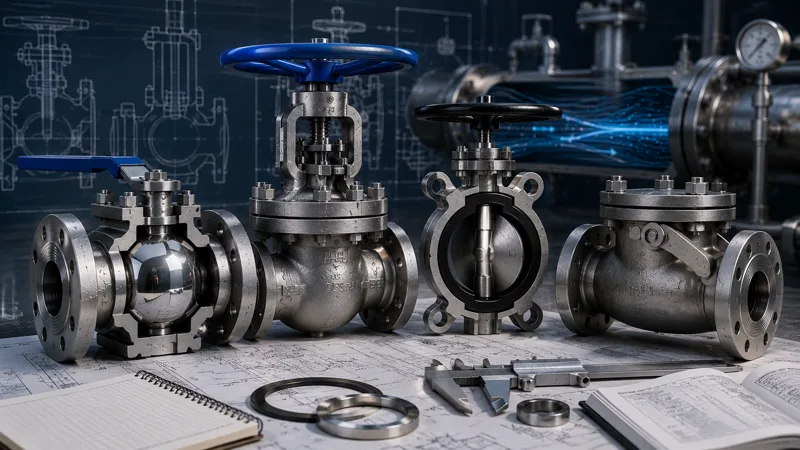
Ball valves are inherently compatible with automated actuators — their quarter-turn operation requires a single actuator stroke, their open and closed positions are mechanically positive and unambiguous, and their torque requirements are well-defined and predictable for actuator sizing. This makes them the standard choice for automated emergency shutdown, remote operation, and on/off process control applications. For a detailed performance and design comparison with gate valves in isolation service, refer to ball vs gate valve design differences. For comparison with butterfly valves in large-diameter and throttling-adjacent applications, refer to butterfly vs ball valve comparison. Both valve type comparisons return to the overview of industrial valve types as the governing classification reference.
Typical Applications
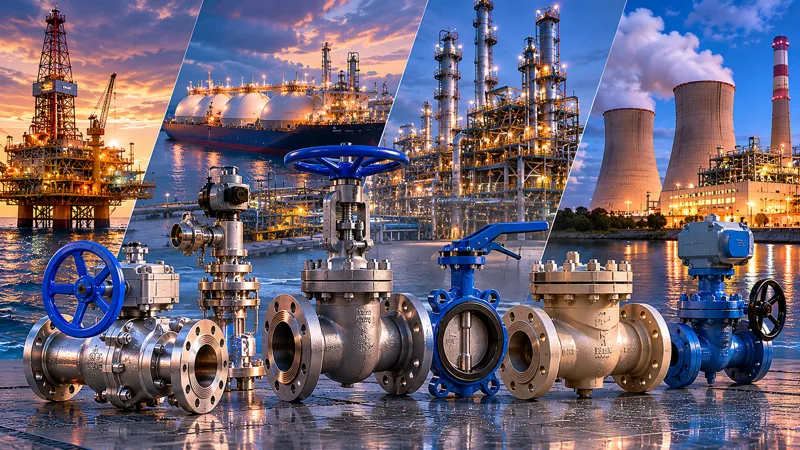
Ball valves are deployed across every major industrial sector where reliable, fast, low-resistance isolation is required — their combination of tight shutoff, compact size, and automation compatibility makes them the most widely specified isolation valve type globally.
Oil and Gas, Chemical, and Water Service
In upstream oil and gas production, ball valves per API 6D are standard as wellhead block valves, manifold isolation valves, and pipeline mainline block valves — their full-bore design enables in-line inspection tool passage and their fire-safe metal-seated designs meet the safety requirements of hydrocarbon service. In chemical processing, ball valves in stainless steel, duplex, and lined designs handle corrosive and hazardous fluids where tight sealing and low fugitive emissions are mandatory. In municipal and industrial water distribution, compact two-piece and three-piece ball valves provide reliable isolation from service connections to large distribution mains.
Power Generation and Extreme Service Applications
In power generation, ball valves serve cooling water systems, fuel gas supply, and auxiliary services — with metal-seated designs used in higher-temperature steam auxiliary service. Specialized ball valve designs extend the application range to extreme service conditions: cryogenic ball valves with extended bonnets, cold-box-compatible trim, and PCTFE seats operate reliably at temperatures to −196°C (−321°F), as addressed in the what is a cryogenic valve reference. High-pressure trunnion ball valves at Class 1500 and 2500 serve the highest-pressure oil and gas service applications, as addressed in the what is a high-pressure valve reference. Both specialized categories are part of the industrial valve category overview.
Frequently Asked Questions
What is the difference between a floating and a trunnion ball valve?
A floating ball valve relies on line pressure to push the unsupported ball against the downstream seat to create the seal — a mechanism that is suitable for small-to-medium bore sizes at moderate pressure classes but produces high operating torque at large bore or high pressure. A trunnion-mounted design mechanically anchors the ball through upper and lower trunnion shafts, keeping the ball in a fixed position and using spring-loaded seats to maintain sealing — producing consistently lower operating torque at large bore and high-pressure Class 600 and above applications per API 6D.
Can a ball valve be used for throttling?
Standard round-bore ball valves — floating or trunnion — are not recommended for continuous throttling service. In the partially open position, the high-velocity flow jet through the crescent-shaped opening between the ball and seat erodes seat surfaces rapidly, degrading shutoff capability within a short operating period. V-port ball valves are specifically designed for controlled flow regulation — their V-shaped bore provides a characterized equal-percentage flow-versus-rotation relationship with rangeability up to 10:1, suitable for limited modulating applications within their design envelope.
What is the difference between full-port and reduced-port ball valves?
A full-port valve has a bore diameter equal to the pipeline bore — producing the minimum possible pressure drop and enabling in-line cleaning pig passage. A reduced-port valve has a bore one pipe size smaller than the pipeline, increasing flow resistance by a factor of approximately 2.5 to 6 relative to full-port at the same flow rate, but allowing a lighter and more compact body. Full-port designs are required wherever pigging access or minimum pressure drop is a design criterion. The complete flow capacity comparison is addressed in the full port vs reduced port valve reference.
How does a ball valve compare to a gate valve?
A ball valve provides faster operation (quarter-turn versus multi-turn), more reliable soft-seated shutoff in clean service, and better suitability for automated operation than a gate valve. A gate valve is often preferred for large-diameter infrequent-operation pipelines where full-bore passage and very low fully-open pressure drop justify the slower multi-turn operation. For detailed comparison, refer to ball vs gate valve design differences and the complete industrial valve guide.
Conclusion
A ball valve is a quarter-turn isolation valve that uses a spherical closure element to provide rapid, low-resistance flow control across a wide range of pressures, temperatures, and process media. Its compact structure, reliable soft or metal-seated shutoff, and inherent compatibility with pneumatic and electric actuators make it the most widely applied isolation valve in oil and gas, chemical, water, and power generation service. Correct selection requires specifying the appropriate bore configuration (full-port or reduced-port), seat material verified for the operating temperature and fluid chemistry, pressure class per ASME B16.34 at the operating temperature, and actuator output verified against the maximum differential pressure breakaway torque. Design selection between floating and trunnion configurations is determined by the combination of bore size and pressure class. Engineers requiring a comprehensive reference that integrates ball valve selection with pressure class, seat design, actuation, and system sizing should consult the complete valve type classification guide as the governing framework for all valve type engineering decisions.