What Is ASME B16.34?
ASME B16.34 is an American Society of Mechanical Engineers standard that defines pressure-temperature ratings, allowable stress limits, wall thickness design requirements, material classifications, inspection criteria, and testing requirements for industrial valves in flanged, threaded, and welding end configurations. It is the foundational pressure rating standard for industrial valves — the reference document that every API product standard (API 6D, API 600, API 602) uses to determine the allowable working pressure at any operating temperature for any valve body material, and a central reference within the valve standards overview hub.
Key Takeaways
- Defines pressure-temperature ratings for industrial valves — ASME B16.34 Tables 2-1.1 through 2-1.3 provide pressure-temperature rating tables for Class 150 through Class 4500 across all standard body material groups, giving the allowable working pressure at every 50°F temperature increment from −20°F to the material’s maximum rated temperature.
- Specifies wall thickness and allowable stress requirements — Section 6 of ASME B16.34 provides the minimum wall thickness design equation and the allowable stress values for each material group at each temperature, ensuring that every compliant valve body has sufficient wall thickness to contain the rated pressure without yielding or fatigue failure.
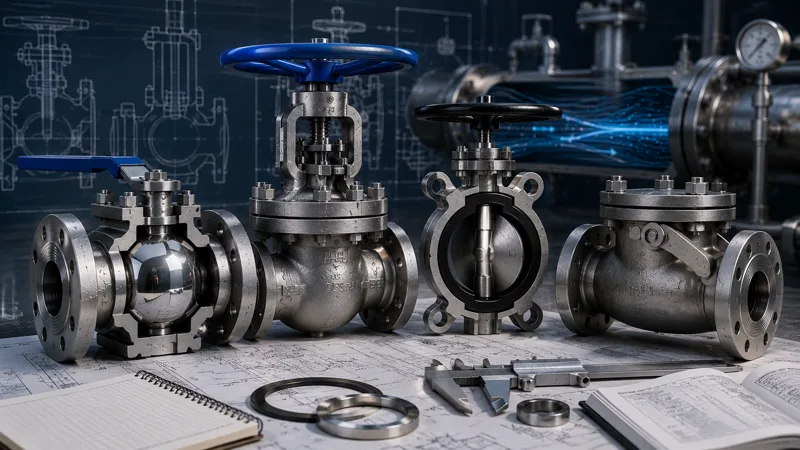
- Applies to multiple valve types and materials — ASME B16.34 covers gate, globe, check, ball, plug, and butterfly valves from NPS 1/4 through NPS 60 at Class 150 through Class 4500, in carbon steel, alloy steel, stainless steel, nickel alloy, and other materials organized into material groups based on allowable stress levels.
- Widely referenced by API valve product standards — API 6D, API 600, and API 602 each specify that pressure-temperature ratings shall comply with ASME B16.34, making B16.34 the universal pressure rating authority for all standard industrial valve specifications.
How It Works
Pressure-Temperature Rating System
The pressure-temperature rating system of ASME B16.34 is built on the fundamental relationship between a material’s allowable stress at a given temperature and the pressure that stress limit permits in a cylindrical pressure vessel of defined wall thickness and diameter. ASME B16.34 defines seven material groups (1.1 through 1.14 for carbon and alloy steels, 2.1 through 2.3 for stainless steels, and additional groups for nickel alloys) — each group contains materials with similar allowable stress-temperature relationships, so all materials within a group carry the same pressure-temperature rating at any given Class designation. For example, Material Group 1.1 contains common carbon steels including ASTM A216 WCB (cast), ASTM A105 (forged), and ASTM A515 Grade 70 (plate) — all assigned the same pressure-temperature rating table because they share essentially the same allowable stress values across the full temperature range. The Class 600 rating for Group 1.1 at 100°F (38°C) is 1480 psi (102 bar); at 400°F (204°C) the rating decreases to 1350 psi (93 bar) as the material’s allowable stress decreases; and at 800°F (427°C) the rating further decreases to 920 psi (63 bar) as the material approaches its creep range. This systematic, material-based pressure reduction with increasing temperature is the core engineering content of ASME B16.34 and the reason it is indispensable for valve selection at elevated operating temperatures. The complete pressure class designation system and how to apply B16.34 tables in valve selection is explained in the ASME pressure class explained reference.
Allowable Stress and Wall Thickness
ASME B16.34 Section 6 provides the minimum required wall thickness equation for pressure-containing valve bodies — the equation is derived from the thin-wall pressure vessel hoop stress formula, modified for the more complex geometry of valve bodies with irregular cross-sections, large openings, and stress concentration features. The minimum wall thickness t at any section of the pressure boundary is given by: t = (P × D) / (2 × S × E + 2 × y × P), where P is the rated pressure at the design temperature, D is the outside diameter at that section, S is the ASME B16.34 allowable stress for the body material at the design temperature, E is the casting quality factor (1.0 for forgings, 0.80 for standard castings, 1.0 for premium quality castings), and y is a temperature coefficient accounting for creep at elevated temperatures. The allowable stress values S for each material group at each temperature are tabulated in ASME B16.34 Appendix A, derived from the ASME Boiler and Pressure Vessel Code Section II Part D allowable stress tables — the same material stress database used for all ASME pressure vessel and piping design. The casting quality factor E is a critical parameter: standard cast valve bodies (E = 0.80) require 25% greater wall thickness than the hoop stress formula alone would dictate, reflecting the statistical probability of undetected flaws in standard casting production. Premium quality castings that have been fully radiographed per ASME B16.34 requirements achieve E = 1.0, reducing the required wall thickness and enabling either lighter-weight bodies at the same pressure class or higher pressure ratings at the same wall thickness.
Inspection and Testing Requirements
ASME B16.34 Section 8 specifies mandatory inspection and testing for all valves manufactured to the standard — shell hydrostatic testing at 1.5 times the rated pressure at room temperature with no visible leakage acceptance criterion, and seat leakage testing at 1.1 times rated pressure with leakage criteria consistent with the applicable valve type and seat construction. These inspection and testing requirements are complementary to and consistent with the more detailed testing procedures specified in what is API 598 — ASME B16.34 defines the test pressures and acceptance criteria while API 598 provides the detailed procedural requirements for test medium preparation, test fixture design, pressure measurement, leakage detection, and test duration. In practice, valve manufacturers performing testing to satisfy both ASME B16.34 and API 598 requirements use the API 598 detailed procedures as their test method, since API 598 compliance automatically satisfies ASME B16.34 testing requirements. Detailed production testing procedures are addressed in the valve pressure testing procedure reference.
Main Components
Pressure Class Tables and Material Groups
The pressure class tables in ASME B16.34 Tables 2-1.1 through 2-1.3 are organized by material group, with each table providing the allowable working pressure in psi (and bar in the SI edition) at temperatures from −20°F (−29°C) to the maximum rated temperature for the group. The Class designation (150, 300, 600, 900, 1500, 2500, 4500) is a dimensionless label that identifies a row in the pressure class table — the actual allowable pressure for a valve of that class depends entirely on the body material group and the operating temperature. A Class 150 valve in Group 1.13 (F91 chrome-moly-vanadium alloy steel for high-temperature steam service) has a rated pressure at 1000°F (538°C) of 230 psi — less than the Class 150 Group 1.1 carbon steel rating of 285 psi at 500°F because F91 is specifically optimized for very high temperature service where carbon steel cannot be used, not for ambient pressure capacity. Material qualification for ASME B16.34 requires that the body material comply with the applicable ASTM specification for the material group, with chemical composition and mechanical property verification documented per the material certificate requirements. The EN 10204 material certificate framework supporting ASME B16.34 material traceability is addressed in the what is EN 10204 3.1 reference.
Design and Marking Requirements
ASME B16.34 design requirements beyond wall thickness include stem retention — the stem must be retained against ejection by line pressure in the event of complete packing failure, with a stem shoulder or flange providing anti-blowout retention at the full rated pressure acting on the stem cross-section at the packing box; body-bonnet joint strength — the bolted bonnet joint must provide sufficient bolt load to maintain gasket seating stress at the rated pressure and temperature, with bolt material, diameter, and number specified to meet this requirement across the full pressure-temperature rating range; and end connection strength — flanged ends must comply with ASME B16.5 or B16.47 dimensional and strength requirements for the applicable pressure class. Marking requirements specify that every ASME B16.34 valve shall be permanently marked with the manufacturer’s name or trademark, nominal size, pressure class designation, body material identification, and end connection standard reference — these markings enable field identification of the valve’s rated pressure and material without reference to documentation. The API product standards that reference ASME B16.34 for their pressure rating requirements include what is API 6D, what is API 600, and what is API 602 — in each case, the product standard’s design requirements supplement ASME B16.34’s pressure rating and wall thickness requirements with application-specific features.
Advantages
Standardization, Safety, and Global Acceptance
ASME B16.34’s most important contribution to industrial valve engineering is providing a single, authoritative, material-based pressure rating system that is accepted globally and referenced consistently by all major valve product standards — eliminating the fragmentation that would result if each product standard defined its own pressure rating methodology independently. The allowable stress-based pressure rating system ensures that every ASME B16.34 compliant valve body has been designed with a consistent safety margin against yielding: the allowable stress values in Appendix A are set at a fraction (typically 1/3.5 of ultimate tensile strength or 2/3 of yield strength, whichever is lower) of the material’s actual strength at the design temperature, providing a defined safety factor against both gross yielding and ultimate failure. ASME B16.34 integrates directly with dimensional standard what is ASME B16.10 (face-to-face dimensions by pressure class) and flange standard what is ASME B16.5 (flange dimensions and drilling by pressure class) — the pressure class designation provides the common reference that links pressure rating, face-to-face dimension, and flange geometry in a consistent, interoperable system. For European projects requiring both ASME B16.34 pressure rating compliance and PED CE marking, the relationship between ASME B16.34 essential safety requirements and PED conformity assessment is addressed in the what is PED 2014/68/EU reference.
Typical Applications
Oil, Gas, Petrochemical, and Power Systems
ASME B16.34 pressure-temperature ratings are the universal basis for valve selection across all industrial sectors — every time an engineer selects a valve for a process service by specifying a pressure class, they are implicitly applying ASME B16.34 to verify that the selected class is adequate for the maximum operating pressure at the maximum operating temperature in the selected body material. In oil and gas upstream service at wellhead and Christmas tree positions, API 6A pressure ratings at 2,000 psi through 20,000 psi are defined independently of ASME B16.34 for the extreme wellhead pressures; however, all downstream pipeline and plant valves from the wellhead to the refinery are rated per ASME B16.34 Class 150 through Class 2500. In power generation, Class 900 through Class 2500 steam valves in ASTM A217 WC9 and F91 alloy steel are specified with ASME B16.34 pressure-temperature ratings verified at the maximum steam temperature, which may approach 600°C in advanced supercritical power plant designs. Specialized service valves — those carrying API 607 fire-safe certification, fire-safe design features, or fugitive emission qualification — still carry ASME B16.34 pressure-temperature ratings as their fundamental pressure design basis. These specialized certifications are addressed in the what is API 607, fire-safe certification, fugitive emission testing, and what is ISO 15848 references, all of which rely on ASME B16.34 as their underlying pressure rating foundation.
Frequently Asked Questions
What does ASME B16.34 cover?
ASME B16.34 covers pressure-temperature ratings, allowable stress-based wall thickness design, material group classifications and their allowable stress values at temperature, body-bonnet joint design, stem retention requirements, end connection strength requirements, marking requirements, and hydrostatic shell and seat inspection testing criteria for industrial valves from NPS 1/4 through NPS 60 at Class 150 through Class 4500 in flanged, threaded, and welding end configurations. It applies to gate, globe, check, ball, plug, and butterfly valve types in standard body materials including carbon steel, alloy steel, austenitic stainless steel, duplex stainless steel, and nickel alloys.
Is ASME B16.34 mandatory?
ASME B16.34 has no inherent legal mandatory status as a voluntary consensus standard. It becomes effectively mandatory when specified in a valve purchase order, referenced by an API product standard (API 6D, API 600, API 602) that is itself specified in the purchase order, or incorporated by reference into a piping system design code (ASME B31.3 Process Piping references B16.34 as the valve rating standard). In practice, ASME B16.34 compliance is a contractual requirement on virtually all industrial valve purchases for process, power, and pipeline service, making non-compliance commercially unacceptable in these sectors.
How is pressure class determined under ASME B16.34?
Pressure class selection under ASME B16.34 requires three inputs: the maximum operating pressure at the valve position, the maximum operating temperature at the valve position, and the body material to be used. The engineer reads the B16.34 pressure-temperature table for the selected body material group and identifies the lowest Class designation whose rated pressure at the maximum operating temperature exceeds the maximum operating pressure with adequate margin. The Class designation is then a fixed property of the valve — a Class 600 valve has the same allowable pressure at any given temperature regardless of which manufacturer produced it or which API product standard governs its design.
Does ASME B16.34 replace API standards?
No — ASME B16.34 and API product standards serve complementary but distinct roles. ASME B16.34 provides the pressure rating and pressure design basis applicable to all valve types; API 6D, API 600, and API 602 provide the application-specific design requirements (pipeline features, refinery construction, compact forged construction) that govern how each valve type is designed and tested for its intended service. A valve specified to API 600 must comply with both standards simultaneously — API 600 for its bolted bonnet design, flexible wedge, and refinery application requirements, and ASME B16.34 for its pressure-temperature rating and wall thickness design basis.
Conclusion
ASME B16.34 is the universal pressure design and rating standard for industrial valves — the foundational document that every API product standard references for pressure-temperature ratings, the allowable stress database that governs body wall thickness design, and the inspection and testing framework that underpins valve pressure integrity verification globally. Understanding ASME B16.34 pressure class tables, material group assignments, and allowable stress concepts is prerequisite to correct valve selection at elevated temperature, interpretation of pressure class designations on nameplates and in specifications, and verification that valve design documentation satisfies pressure containment safety requirements. Engineers requiring a comprehensive framework that integrates ASME B16.34 within the full landscape of valve design, testing, dimensional, and certification standards should consult the valve standards overview hub as the governing reference for all valve pressure rating standards navigation.